
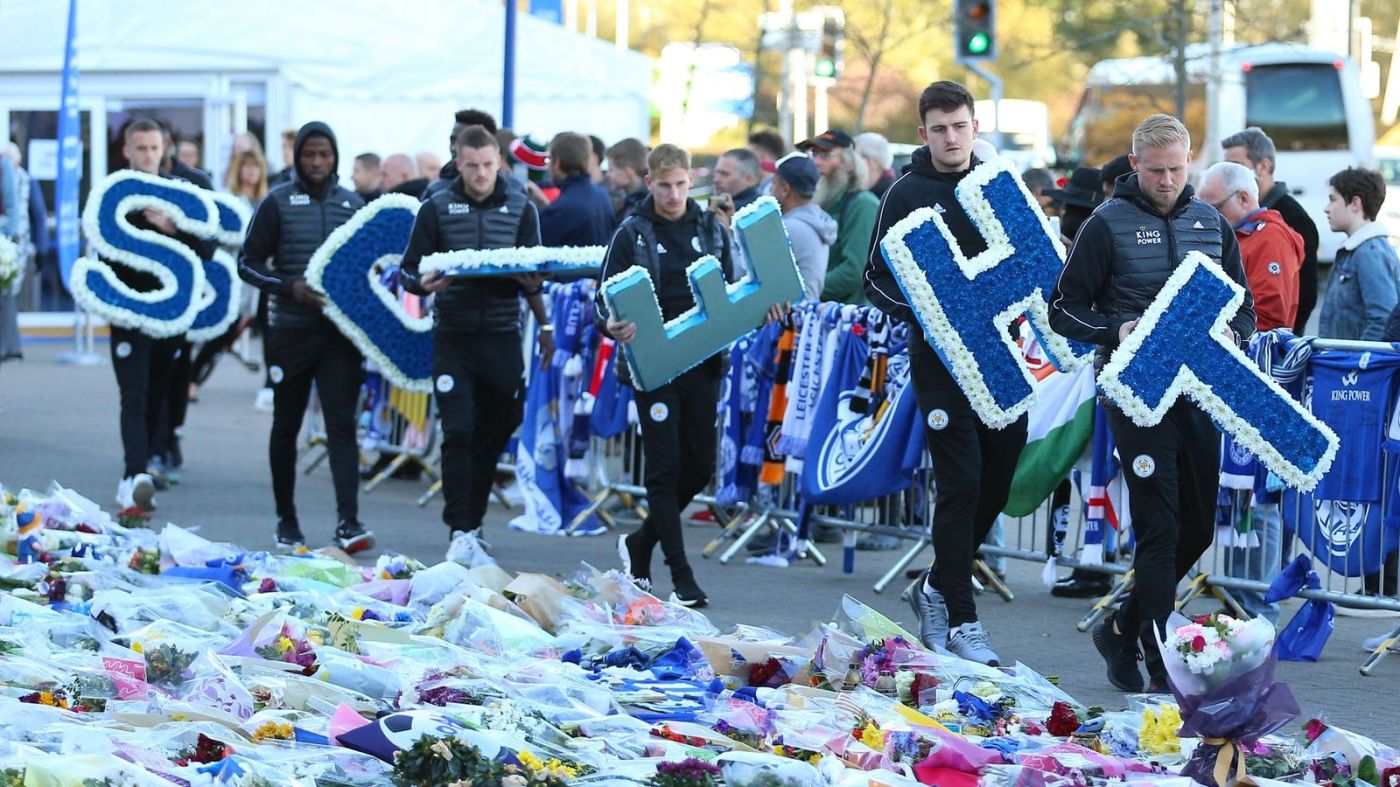
The recently released Air Accidents Investigation Branch report concludes that the pilot of the helicopter that crashed after a tail rotor failure near the King Power Stadium in 2018 was unable to regain control.
The UK’s aviation accident investigator concluded that the fatal helicopter crash in 2018, which claimed the life of Leicester City owner Vichai Srivaddhanaprabha, was caused by the pilot’s inability to recover from a tail rotor failure.
In the tragic helicopter crash near the King Power Stadium, Pilot Eric Swaffer, his partner Izabela Roza Lechowicz, and two members of Vichai’s staff, Nusara Suknamai and Kaveporn Punpare, lost their lives.
The Air Accidents Investigation Branch (AAIB) has reported that a helicopter experienced an uncontrollable yaw and rapid descent due to a failure in the tail rotor.
“The investigation found that, in the prevailing circumstances, the loss of yaw control was irrecoverable,” it said in its final report on the crash.
The pilot skillfully landed the helicopter, allowing four out of five passengers to survive the impact, as confirmed by post-mortem examinations.
“Their reported injuries would, however, have prevented them from being able to escape from the helicopter without external assistance, given the position in which it came to rest,” AAIB said.
The helicopter was tilted to the left and had damaged fuel tanks that caused a significant leak which quickly caught fire.
According to the report, the police officers arrived promptly at the scene of the crash but were unable to break the helicopter’s windscreen to rescue those inside. Tragically, the fire resulted in the death of all onboard.
The investigators determined that the crash of the Leonardo AW169 helicopter was caused by problems with the tail rotor bearing.
Leonardo, an Italian company, has issued 16 service bulletins for a particular model, including additional inspection requirements.
The report indicates that the pilot could not have prevented the crash, according to litigation specialists representing the families of Vichai, Swaffer, and Lechowicz.
Litigation has started in Italy against Leonardo on behalf of the families of Swaffer and Lechowicz. Vichai’s family is also considering legal action against the manufacturer.
“I am deeply saddened by the course of events,” Vichai’s son, Aiyawatt, said in a statement. “Almost five years after my father’s passing, this report provides concerning evidence against Leonardo.”
Leonardo did not respond to a request for comment outside normal business hours.
The report commends the work of the Air Accidents Investigation Branch and hopes it will contribute to future aviation safety. It acknowledges the tragic events of October 27, 2018, when Leicester City experienced the loss of their chairman, friends, colleagues, and family members.
“Yet, in our grief, a sense of unity and strength was forged. The extraordinary support and kindness that was extended to those affected, by communities across Leicestershire, football and the wider world will never be forgotten.
“As we near the fifth anniversary of the accident, the families and loved ones of Khun Vichai, Kaveporn, Nusara, Eric and Izabela remain always in our thoughts, as those we lost remain always in our hearts.
“As a club, we continue to feel the loss of Khun Vichai, who loved his club, the city it calls home and the communities it represents. Our ongoing commitment to Khun Vichai’s vision, led with the same passion and devotion by Khun Aiyawatt and the Srivaddhanaprabha family, will be our lasting tribute to the memory of those we lost, and a reflection of the ambition, dedication and sense of community that brought us all together under Khun Vichai’s leadership.”
The AAIB report mentioned that the European Union Aviation Safety Agency (EASA) had issued nine airworthiness directives for Leonardo’s AW169 and AW189 helicopter models.
The final report made several recommendations to EASA, including changes to certification requirements and risk assessment processes.
EASA was unavailable for comment after regular business hours.
 World of sports
Leave a comment