
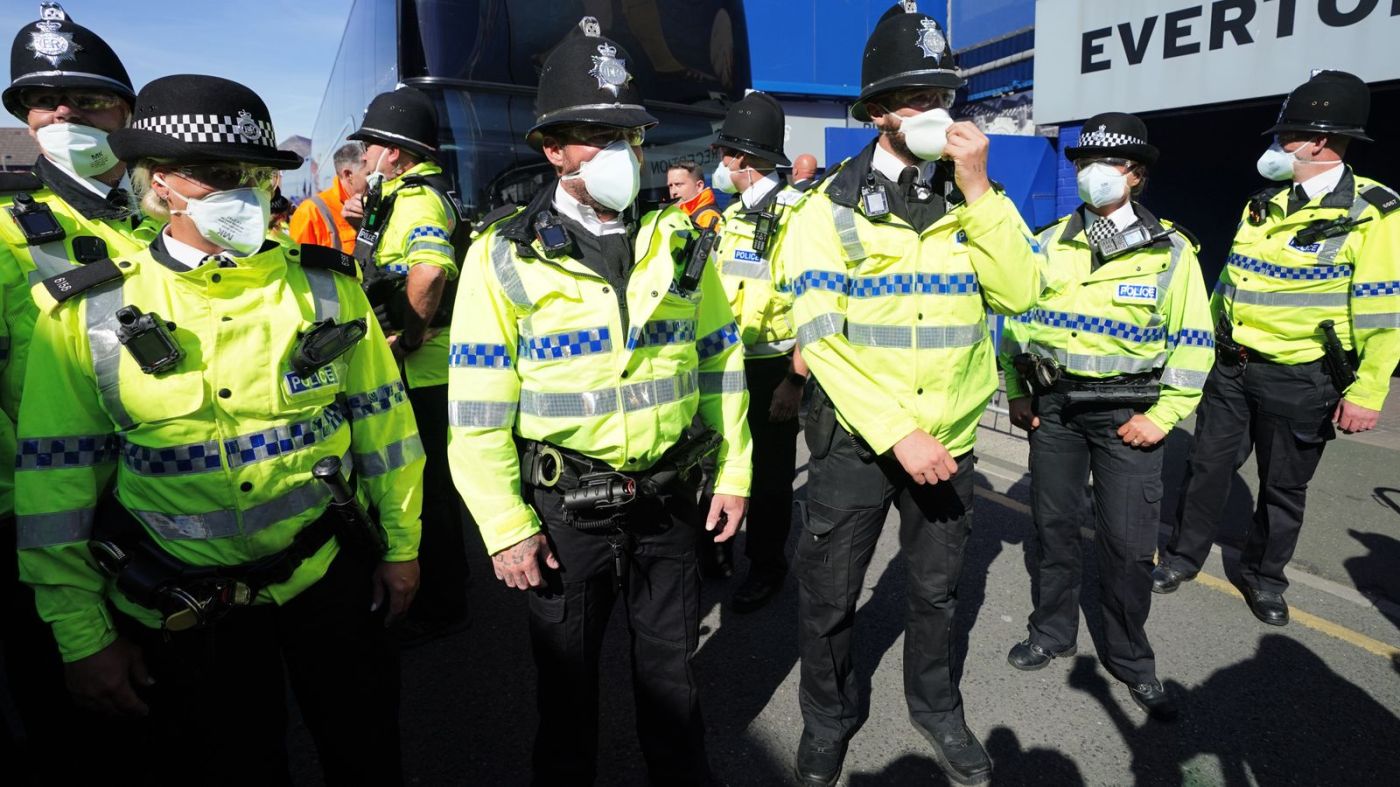
Last season, incidents of hate crime were reported in relation to 370 games, which was about 12% of all matches. On average, there were only five arrests for every 100,000 supporters who attended stadiums, according to statistics released by the Home Office.
Last season, UK police issued the most football banning orders in over ten years, but a record-breaking 45 million people attended men’s football matches in the country.
According to the Home Office, there were only five arrests per 100,000 fans at stadiums on average.
“That 45 million is the highest attendance figure ever,” Chief Constable Mark Roberts, the head of UK football policing, has told Sky Sports News.
“So that shows the vast majority of people going to football matches behave, and enjoy themselves. That’s important. We need to shake off this idea that this (football disorder) is an English problem.
“Recent events in Eastern Europe, and Ajax for example, show how bad things can be, and we need to keep it in context.
“And whilst we will never brush the bad behaviour of supporters under the carpet, it’s important we get that message across and avoid giving England fans a bad name, because that affects policing.”
- 45 million people attended men’s domestic and international matches in 2022/223 – a record number.
- Arrest rates were five per 100,000 attendees
- Incidents were reported at 1,516 football matches – that is 50% of all games (and is a broadly similar figure to the previous season).
- Hate crime incidents were reported in relation to (not necessarily at) 370 games (12% of matches).
- The use of pyrotechnics (at 620 matches) and throwing of missiles (at 573 matches) is of particular concern to police.
- There are currently 1,624 football banning orders in force in England and Wales
- Of those, 682 new banning orders were issued last season (highest number since 2010/11)
- 200 arrests were made for the possession of Class A drugs, in or around football stadiums – this offence has now been raised to a “Schedule 1” offence meaning it will be treated more seriously by the courts.
Recent international tournaments have also had great results.
“At the World Cups recently in Russia and Qatar,” Chief Constable Roberts says, “the behaviour of England and Wales fans was probably better than anyone else there.”
In the past season, UK courts issued 682 new football banning orders. This is a 32% increase compared to the previous season and the highest number since 2010/11.
According to Chief Constable Roberts, the police consider those measures as their most powerful tool to prevent football disorder, so they should not be seen as something bad.
“We are taking really strict enforcement action. You often see a small number of ringleaders have a disproportionate impact on the rest of the crowd. So if we can take them out of the game, that has a really positive impact…..and makes it a better experience for everyone else.”
Incidents of hate crime were reported in 370 games last season, accounting for 12% of matches. The police have acknowledged an increase in homophobic abuse and tragedy chanting, although they are not specifically recorded in the Home Office figures.
“That sounds a high number, but we think that is a good sign because it is down to better reporting,” Chief Constable Roberts insists. “We are seeing some positive results in the courts, and also with banning orders, so that should tell people we will do everything we can to track them down.
“Racist and tragedy chanting diminished for a while, it was pretty rare (in the early and mid-90s) but it’s been really disappointing to see that on the rise again. We can speculate on the causes of that – social media maybe, encouraging people to talk in a way which is socially unacceptable.
“But people should be aware we will always pursue that, and take action wherever possible, and when the evidence is there.
“Chanting on sexual orientation or race is very clearly defined as a hate crime – it can be more difficult with tragedy chanting to show who has taken offence, and build the evidence. But we take it very seriously, and we want to squeeze it out of the game.”
The Home Office statistics now include the use of Class A drugs and arrests related to football matches, both within stadiums and in places like pubs where football is considered a factor in the incidents.
“Cocaine, mixed with alcohol and the excitement of a football match, often drives really poor behaviour,” Chief Constable Roberts explains. “So we are really pleased to see the punishments for that increased, working closely with the CPS as we do.”
The police are particularly concerned about the use of pyrotechnics, despite the recent increase in overall arrests due to the addition of two new categories.
“Clearly, pyrotechnics and missile throwing is very dangerous. We have seen people seriously injured.
“We will often see people glorifying pyrotechnics – please don’t. When people pick these up, you don’t know whether it’s going to just smoke, or explode. And it can, if we are being blunt, blow someone’s hand off.
“We need that concerted effort around enforcement and education.”
Out of the 682 new banning orders, nearly all (99.6%) were given to males. The majority (70%) of them were between the ages of 18 and 34, while a small percentage (2%) were 17 years old or younger.
Manchester United had the most banning orders with 69, the highest number in the past few seasons. Millwall came in second place with 66 banning orders.
123 arrests were made for England and Wales matches abroad. 101 were linked to the men’s World Cup in Qatar, and none were connected to the Women’s World Cup.
The number of online hate crimes rose from 103 to 234, but this increase is mainly due to improved reporting and recording.
 World of sports
Leave a comment