
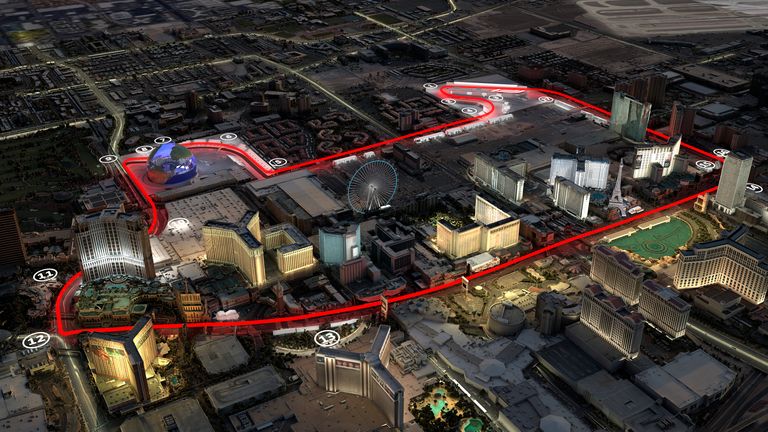
Las Vegas Grand Prix CEO Renee Wilm explains how the city made its way back onto the Formula 1 calendar in an interview with Sky Sports F1.
Ahead of this weekend’s Las Vegas Grand Prix, race chief executive Renee Wilm shares with Sky Sports F1 how the event was created.
The story of Vegas’ return to F1 started in 2021. The popularity of the sport in the USA reached new heights thanks to Netflix’s Drive to Survive and an exciting title battle between Max Verstappen and Lewis Hamilton.
Liberty Media, the owner of F1’s global commercial rights, is considering the best ways to keep the momentum going.
A deal was confirmed for the first Miami Grand Prix in 2022, but that event was not the final goal.
Wilm recalls: “So about two and half years ago, I started coming out to Las Vegas to meet with the regulators and the property owners in order to get their buy-in on basically shutting down the strip for what we knew would be an epic event.”
Getting the approval was a major challenge for Wilm and her team. They had to find a compromise between the owners of Vegas’ famous establishments and the city’s residents.
“Once we were able to gain traction and support for our project, we announced that we would be holding the first-ever Las Vegas Grand Prix in March of 2022 and from that point forward, it has been full speed ahead,” Wilm says.
With Liberty Media promoting their own F1 event, Wilm moved from being the company’s chief legal and administrative officer to leading the new project.
Ultimately, it wasn’t just goodwill that convinced the important people, especially some of the famous places on The Strip, to agree to a major change in how things usually work.
On a typical weekend, Las Vegas is already bustling with visitors. However, when the F1 race comes to town, an even larger and more prestigious crowd is expected. This influx of people should compensate for any inconvenience that businesses may experience.
Wilm explained: “So we are projected, with help of our consultants, that we will be bringing $1.2 billion of economic value to the valley that weekend.
“And that is inclusive of all of the personnel that we have engaged as well as all of the revenue that will be generated by our local partners, and then obviously the tax revenue that is being generated for the benefit of the state of Nevada as well as the Clark County.
“So all in this is going to be tremendously impactful, economically.
“I think our partners, including our founding partners, MGM, Wynn, Caesars, are very excited about bringing their level of Ultra VIP Entertainment and hospitality to the F1 fan base.”
Additionally, thanks to F1, some of the city’s most used roads have had a makeover.
“We have re-asphalted the entirety of the 3.8-mile track,” Wilm said. “That includes much of the public right of way as well as the private land that we Liberty Media acquired on the corner of Harmon and Coval, which is the home of Formula One in North America and houses our brand new pit building.”
The event organizers are concerned about how the cold evening temperatures might affect the performance of the cars.
F1 races are often held in countries where the heat lingers even after the sun sets, while in other places, it follows the sun as it travels around the world.
The temperature during qualifying and the race is expected to be around 10 degrees Celsius.
The upcoming race may be the coldest since the 1978 Canadian Grand Prix when the temperature during the race dropped as low as five degrees Celsius.
While the conditions may pose challenges for drivers and teams, especially in maintaining their tires at the optimal temperature, Wilm is not overly worried.
“I think the drivers will be quite happy to not be racing in the tremendous heat that they have experienced of late,” she said. “You can always put layers on, it’s hard to take layers off.”
“And we have been working closely with the teams, the sporting department at Formula 1 and having conversations with Pirelli to ensure that we will have a high-quality degree of racing and that the tyres that will be brought to town for this event have been carefully chosen, given the variety of temperatures that could be experienced at night here in November.”
As for the spectators, Wilm says: “The electricity and the excitement that will be coming off the track and just the throngs of people that are going to be enjoying the race weekend together, I think will definitely raise temperatures enough so everyone will be comfortable.”
And if you’re wondering why the race is starting so late, it’s for you! The start times were pushed later largely to allow European audiences to watch qualifying and the race live over breakfast, instead of in the middle of the night.
“So we in America get up early with a cup of coffee and enjoy watching the European races,” Wilm says. “And now that is essentially being reversed and we would invite everyone in Europe to enjoy watching what will be a historic event with their morning coffee.”
The organizers want to create a great experience for both TV viewers and event attendees.
“I think we are bringing a Formula 1 race weekend to a whole new level of fan engagement and fan entertainment,” Wilm said.
“We have taken steps that are quite different from any other races on the calendar. For example, our grandstands and general admission are all-inclusive, non-alcoholic food and beverage, catered by the very well-known Wolfgang Puck.
“This is an opportunity for fans to engage and enjoy the experience, not have to stand on long queues, not have to spend a tonne of money on food because they purchased a ticket where we are basically embracing them and providing them with that great experience on track.
“Our Paddock club is the largest paddock club on the calendar and we have held nothing back in terms of creating that ultra-VIP hospitality opportunity, coupled with Las Vegas’ unique entertainment.
“So think about the roaming Cirque du Soleil’s and Blue Man Group and just really creating this new level of entertainment that we’re hoping will set a new standard across our calendar.”
For Wilm and Liberty media, they are hoping the event to be the final piece of their American jigsaw, at least for now.
“You look at the three American races, each with its own unique identity,” she said. “Austin, the heartland of America. Miami, the glamour, the Latin flavour and now Las Vegas, the home of glamour, and now to be married with speed.
“So those three races together really highlight what we think are some of the greatest aspects of the United States and how we can bring our sport into the everyday lives of Americans.”
 World of sports
Leave a comment