
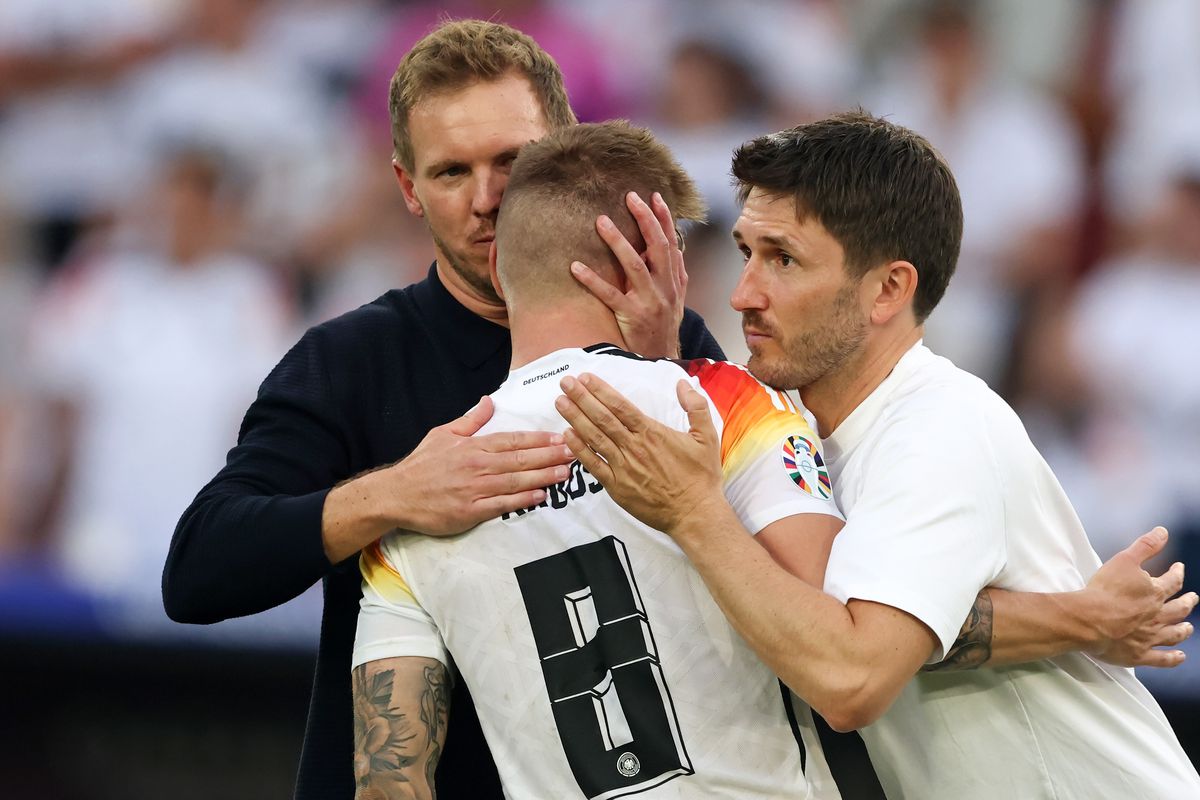
Julian Nagelsmann’s reaction to Germany’s elimination from Euro 2024 following the controversial handball incident amidst their match against Spain has sparked widespread discussion across the footballing world. Despite the disappointment and evident frustration, Nagelsmann remained composed, emphasizing that while his team’s exit was deeply disheartening, he did not perceive it as a case of being “robbed.”
Undoubtedly, the non-award of a late penalty following Marc Cucurella’s handball has ignited calls for a reevaluation of the handball rule. Nagelsmann expressed his belief that the rule in its current form requires revision, advocating for a more comprehensive consideration of the impact of potential handball incidents on the outcome of matches. Furthermore, he highlighted the potential for modern technology to enhance the decision-making process, ensuring a more seamless and accurate approach to such critical moments in football.
In a moment of reflection and guidance for his squad, Nagelsmann conveyed to his players that they should not carry the burden of feeling undeserving of their exit from the tournament. He lauded Germany’s unity and perseverance, deeming it a valuable lesson for society at large, transcending the realm of football.
“There is a rule and I hope there is no wrong decision. They applied the rule and it was not a penalty. I do not feel cheated. For me the question is about making it more practical, more logical, in terms of how this [handball] rule is assessed. I say this for football [in general] not today. You look at the hand, if it is at 3 o’clock, if it is a bit higher or a bit lower. But there are people with bigger muscles than me, different movements.
“I don’t understand why we don’t take into account what is happening with the ball. If Musiala kicks it towards Stuttgart centre and it hits the hand, I won’t say anything. But it was going towards goal. And for me, you should look at where it is going. Is it going into the clouds or is it going in the goal? In one case it is a penalty, in the other it is not. If it is going into the stands, then it is no penalty. The rule should be simpler. You can’t talk about intentions. You have to see where the ball is aimed. We have 50 robots that bring us our coffee so there should be an AI that calculates where the ball is going.”
He added: “In the second half we reacted, after the 60 minutes we were clearly the better team with many clear chances and towards the end, that we scored was well deserved. With the exception of the first five minutes of second half of extra time, it was almost only us that wanted to win. We invested so much. We hit the post, we had a header, we had a chance we missed by two centimetres and with the last chance we conceded.
“I told the players we didn’t deserve this. There was a great togetherness. In six weeks we did not have a single situation in which I had to intervene. We had a very good atmosphere. The accusations of the past – that we didn’t want to win – wasn’t seen for a second. We are a country that is too sad in too many situations, with a dark perspective on things, and I hope this symbiosis can create something. We are stronger with unity, when we think about what we can do together; together with your neighbour you are stronger. This unity here felt good.”
The narrative of the dramatic match between Germany and Spain, culminating in Mikel Merino’s late winner, serves as a testament to the unpredictable and captivating nature of football on the grand stage. The emotional rollercoaster, encompassing the late equalizer by Germany and the subsequent heartbreak, has once again underscored the immense passion and significance attached to international football tournaments.
 World of sports
Leave a comment