
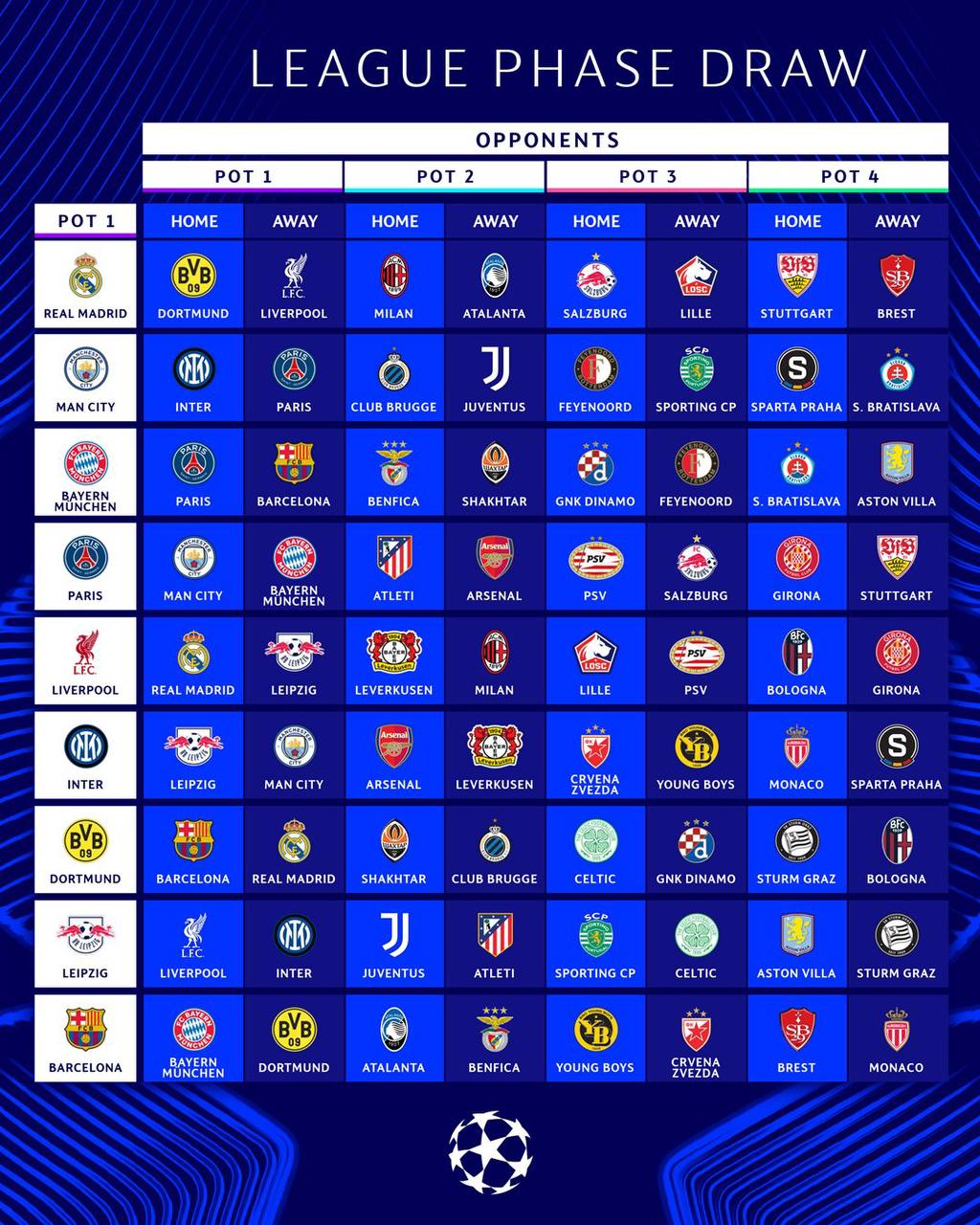
The 2024/25 UEFA Champions League will feature a new format, impacting fans and UEFA’s other club competitions.
European football’s enduring success and popularity can be attributed to its continuous evolution and adaptation, exemplified by the UEFA Champions League’s transformation since its inception as the European Champion Clubs’ Cup in 1955.
UEFA consulted with key stakeholders to design the new 2024/25 format for European club competitions, which was approved on 10 May 2022 following a decision made on 19 April 2021.
The UEFA Executive Committee has announced reforms that will change the current group stage system of the Champions League. Starting from the 2024/25 season, 36 clubs will participate in a single league competition, allowing four more clubs the opportunity to compete against the best in Europe.
Teams in the new league format will play eight matches in the league phase, facing fixtures against eight different teams with half of the matches at home and the other half away. The opponents will be determined by ranking the teams in four seeding pots, with each team drawn to play two opponents from each pot.
Clubs can now test themselves against a wider range of opponents, leading to more frequent matchups between top teams and increased competitiveness across the board.
Qualification for the Champions League will still depend on a club’s final position in the previous season’s domestic league and the association club coefficient ranking, with the access list remaining the same as the current season. Additionally, four extra slots available in 2024/25 will be allocated accordingly.
Slot one: This place will go to the club ranked third in the championship of the association in fifth position in the access list, which is determined by the UEFA association club coefficient ranking.
Slot two: This place will be awarded to a domestic champion by extending from four to five the number of clubs qualifying via the Champions path of the competition’s qualifying process, which will consist of four qualifying rounds.
Slots three and four: These places will go to the associations with the best collective performance by their clubs in the previous season (i.e. the association club coefficient of the previous season, which is based on the total number of club coefficient points obtained by each club from an association divided by the number of participating clubs from that association). Those two associations will each earn one automatic place in the league phase (‘European Performance Spot’) for the club ranked next-best in their domestic league behind those clubs that have already qualified directly for the league phase.
Each match’s outcome determines the league’s ranking, with three points for a win and one for a draw remaining the standard.
The top eight sides qualify automatically for the round of 16, while teams finishing in 9th to 24th place compete in a two-legged knock-out phase play-off. Teams that finish 25th or lower will be eliminated without access to the UEFA Europa League.
The new format will increase the stakes for all teams until the end of the league phase.
Teams finishing between 9th and 16th will be seeded for the knockout phase play-off draw, facing teams placed 17th to 24th. The winners will advance to the round of 16, where they will meet the top eight finishers who are already seeded.
The knockout phase pairings will be influenced by the league phase rankings, creating a clearer route for teams to reach the final and providing added sporting incentive during the league phase.
From the round of 16 onwards, the competition will continue with knockout rounds leading to the final at a neutral venue selected by UEFA.
All games before the final will be played on weekdays, to accommodate the domestic calendar across Europe, while the final will be played on a Saturday.
The UEFA Europa League and UEFA Europa Conference League will undergo similar format changes, with both competitions featuring 36 teams in the league phase. The UEFA Europa League will have eight matches against eight different opponents, while the UEFA Europa Conference League will have six matches against six different opponents, starting from the 2024/25 season.
The Champions League and Europa League matches will be played from September to January, while Europa Conference League matches will take place between September and December. Each UEFA club competition will have one exclusive matchweek, with the other two competitions not scheduled during that week.
Champions League matches are usually played on Tuesdays and Wednesdays, while Europa League and Europa Conference League matches take place on Thursdays. However, during certain weeks, matches may be scheduled differently, with Champions League exclusive weeks featuring matches on Tuesday, Wednesday, and Thursday, Europa League exclusive weeks with matches on Wednesday and Thursday, and Europa Conference League exclusive weeks with matches only on Thursday.
All games on the final matchday of each league phase will be played simultaneously.
The new league format will include more European teams in each competition and offer fans the opportunity to watch a greater number of top European matches at an earlier stage in the competition.
The new format aims to achieve a better competitive balance among all the teams by enabling each team to compete against opponents of a similar level throughout the league phase.
Every game in the new league format is crucial and has the potential to significantly impact a team’s position, right up to the final matchday. Winning or losing the last game could determine whether a team qualifies for the last 16, enters the play-offs, or is eliminated from the competition.
The changes aim to secure the future of European football and meet the needs of all stakeholders, confirming commitment to open competition and sporting merit. The new UEFA club competitions landscape will allow more teams, coaches, and players to compete in more competitive European games while sustaining domestic leagues.
UEFA has reaffirmed its strong financial commitment to European football and announced steps to guarantee solidarity to clubs not participating in UEFA club competitions, reinforcing the game’s solid foundation in Europe.
Our Champions League and Europa League timelines outline the evolution of each competition, starting from the European Champion Clubs’ Cup in 1955 to the current UEFA men’s club competition formats.
 World of sports
Leave a comment