
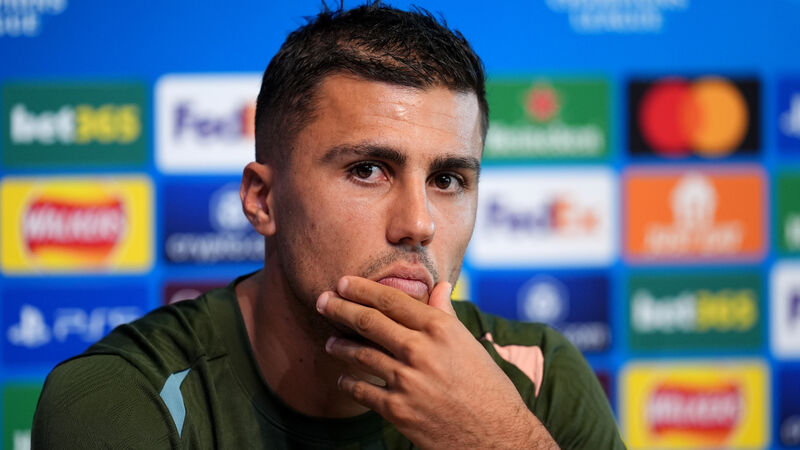
The concerns voiced by Manchester City midfielder Rodri regarding the increased number of games resonate deeply with players across various clubs and competitions. The significant expansion of the Champions League format, coupled with the impending inaugural 32-club Fifa Club World Cup, has given rise to mounting apprehensions regarding player workload and exhaustion.
The 28-year-old was asked whether striking was an option to try to curtail the demand. “Yeah, I think we are close to that – it is easy to understand,” he said. “If you ask any player he will say the same; it is not the opinion of Rodri or whatever. It’s the general opinion of the players. And if it keeps this way, there will be a moment where we have no other option.
“I really think but let’s see. I don’t know what’s going to happen but it’s something that worries us because we are the guys that suffer.”
Rodri was asked the optimum amount. “I don’t have an exact number,” he said. “From my experience I can tell you that 60-70 [is no good]. No. Between 40 and 50 is the amount of games in which a player can perform in the highest level. After that you drop because it is impossible to sustain the physical level.
“This year we can go to 70, maybe 80, I don’t know. It depends how far you go in the competitions. In my humble opinion I think it is too much. I think we have to take care of ourselves. Someone has to take care of ourselves because we are the main characters of this sport or business or whatever you want to call it. Not everything is money or marketing, it is also the quality of the show. When I am not tired I perform better and if the people want to see a better football, we need to rest.”
Echoing Rodri’s sentiments, Liverpool’s Alisson expressed similar sentiments, underscoring the weariness felt by players with the continuous addition of matches. “Nobody asks the players what they think about adding more games, so maybe our opinion doesn’t matter,” the goalkeeper said. “But everyone knows what we think about having more games. Everybody is tired of that.”
This widespread concern underscores the urgency of addressing the balance between competitive demands and the well-being of the players who are instrumental to the sport’s success. Additionally, the example of Erling Haaland, who faced the prospect of an exceptionally long period without a break due to club commitments, further underscores the pressing need to consider the impact of extended seasons on players’ physical and mental health.
 World of sports
Leave a comment