
On Wednesday morning, when many Americans learned about Donald Trump’s victory in the 2024 presidential election, he had already received a congratulatory message from a well-known sports supporter.
“Congratulations Mr. President!” declared FIFA president Gianni Infantino in an Instagram post filled with emojis. He expressed optimism for a successful FIFA World Cup and FIFA Club World Cup in the United States.
Infantino rounded off his message by tagging Trump, a relationship that dates back to at least 2018, indicating that he will be looking to foster this connection further.
Infantino appeared satisfied — possibly, speculated soccer industry insiders, because the political landscape could be beneficial. Three sources shared with Yahoo Sports that Trump’s authoritative governance style might assist FIFA in organizing the upcoming 2026 men’s World Cup, set to take place in the U.S. in collaboration with Mexico and Canada. One insider referenced a well-known statement from Jérôme Valcke, FIFA’s former general secretary from 2013: “Less democracy is sometimes better for organizing a World Cup,” highlighting the ongoing challenges in planning for the 2026 event.
In discussions leading up to and following the election, various officials involved in the World Cup’s preparations mentioned that the effects of a Trump presidency remain uncertain. “It’s too early to tell,” noted one observer.
Some emphasized that Trump’s isolationist policies, along with his anti-immigrant rhetoric, unpredictability, and divisive nature, introduce variables that could complicate an event marketed as one that seeks to “unite the world.”
Despite the uncertainty, there is a consensus that Trump will enthusiastically support the World Cup — and subsequently, the 2028 Olympics. Some foresee him together with Infantino, reminiscent of Vladimir Putin’s prominent role during the 2018 World Cup in Russia, as the U.S. hosts an extraordinary spectacle. “Trump is definitely going to get involved,” remarked one insider. “He will relish the political aspects.”
Therefore, it is anticipated that his administration will actively participate in the tournament’s organization, albeit once they manage their other commitments.
Planning for World Cups is a meticulous process requiring extensive coordination. FIFA, which governs the sport globally and operates the event, has traditionally depended on local organizations to manage financial and logistical responsibilities. For instance, in Russia, a central organizing committee was created by both the Russian government and the Russian Football Union. Qatar established the Supreme Committee for Delivery & Legacy in collaboration with FIFA. As for North America, FIFA’s increased involvement necessitates close cooperation with local host committees in each city involved. These committees work alongside their respective governments — local, state, and federal — to secure necessary funding and operational support, a process that naturally brings the U.S. president into play.
Over the years, FIFA and the host committees have built relationships within Congress as well as with the Joe Biden administration, advocating for federal support, particularly regarding security issues. FIFA even brought on a government relations head, Alex Sopko, directly from Biden’s Office of Intergovernmental Affairs.
With the new administration, however, these relationships will need to be reestablished. Although some lower-level staff members may remain, Trump will appoint an entirely new cabinet and deputies. This transition, as noted by three individuals familiar with the World Cup preparations, could lead to delays in operations. It may also disrupt ongoing discussions about security measures and visa processes.
One individual familiar with these efforts shared via email, “A Kamala Harris administration would have been more likely to hit the ground running and build on the efforts of the current administration to prepare for the World Cup. The incoming Trump administration will face numerous priorities, with a significant focus on border issues and enforcement. Therefore, I suspect it will be harder to capture their attention in the initial stages. Preparations for the World Cup are likely to take a back seat.”
Conversely, some argue that once the World Cup becomes a priority, Trump and his advisors may be more inclined to bypass conventional processes, simplify bureaucracy, and provide Infantino with the support he needs.
Instead of navigating through a complicated array of departments, like Homeland Security and State, Trump could, “if this is a priority for him,” expedite the World Cup planning process, suggested Travis Murphy, a former State Department officer now serving as the CEO of Jetr Global Sports + Entertainment.
This method of operation resonates well with Infantino, who has a history of establishing relations with authoritarian leaders, including Putin and Saudi Arabia’s Mohammed bin Salman. He is accustomed to negotiating with singular, influential figures — whether they be presidents of national soccer federations, sports ministers, or heads of state — to achieve his goals.
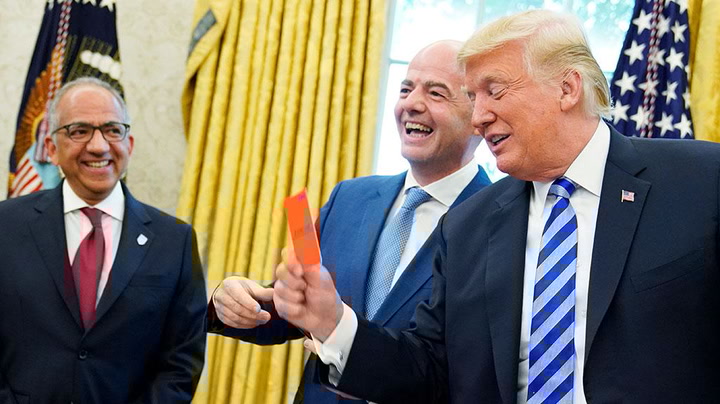
In 2018, this is precisely what prompted his outreach to Trump. Following FIFA’s decision to award North America the hosting rights for the 2026 World Cup, Infantino secured a meeting in the Oval Office where he presented Trump with gifts and cultivated their cordial relationship. A few meetings later, during the 2020 World Economic Forum in Davos, Switzerland, Infantino praised Trump, who reciprocated the gesture by calling Infantino a “great friend.”
Fast forward four years to this past May, and the two met again at a Formula 1 race in Miami. Conversely, in that same period, Infantino has been unable to arrange a meeting with Biden at the White House. This situation compelled FIFA to navigate the bureaucratic landscape, which became a source of frustration. Some insiders joked that “FIFA forgot how democracy worked.”
For these reasons, Trump’s recent election is perceived by some as a favorable turn for FIFA or, at the very least, for Infantino. Speculation suggests that Infantino, now residing in South Florida, may seek to arrange a meeting during the presidential transition at Trump’s Mar-a-Lago resort in Palm Beach.
However, others remain apprehensive regarding potential policy implications. Trump has promised what he termed the “largest deportation operation in American history” and has consistently called for stringent immigration controls. He has alluded to implementing a “travel ban” even more robust than his first administration’s efforts, which imposed severe limitations on travel from various predominantly Muslim nations.
This proposed ban could exacerbate concerns about the ability of thousands of World Cup fans to enter the United States. As it stands, consular officials already deny approximately 24% of applicants seeking B1/B2 visitor visas, based on 2023 State Department statistics. Additionally, some applicants face delays of over a year merely to secure an interview.
 World of sports
Leave a comment