
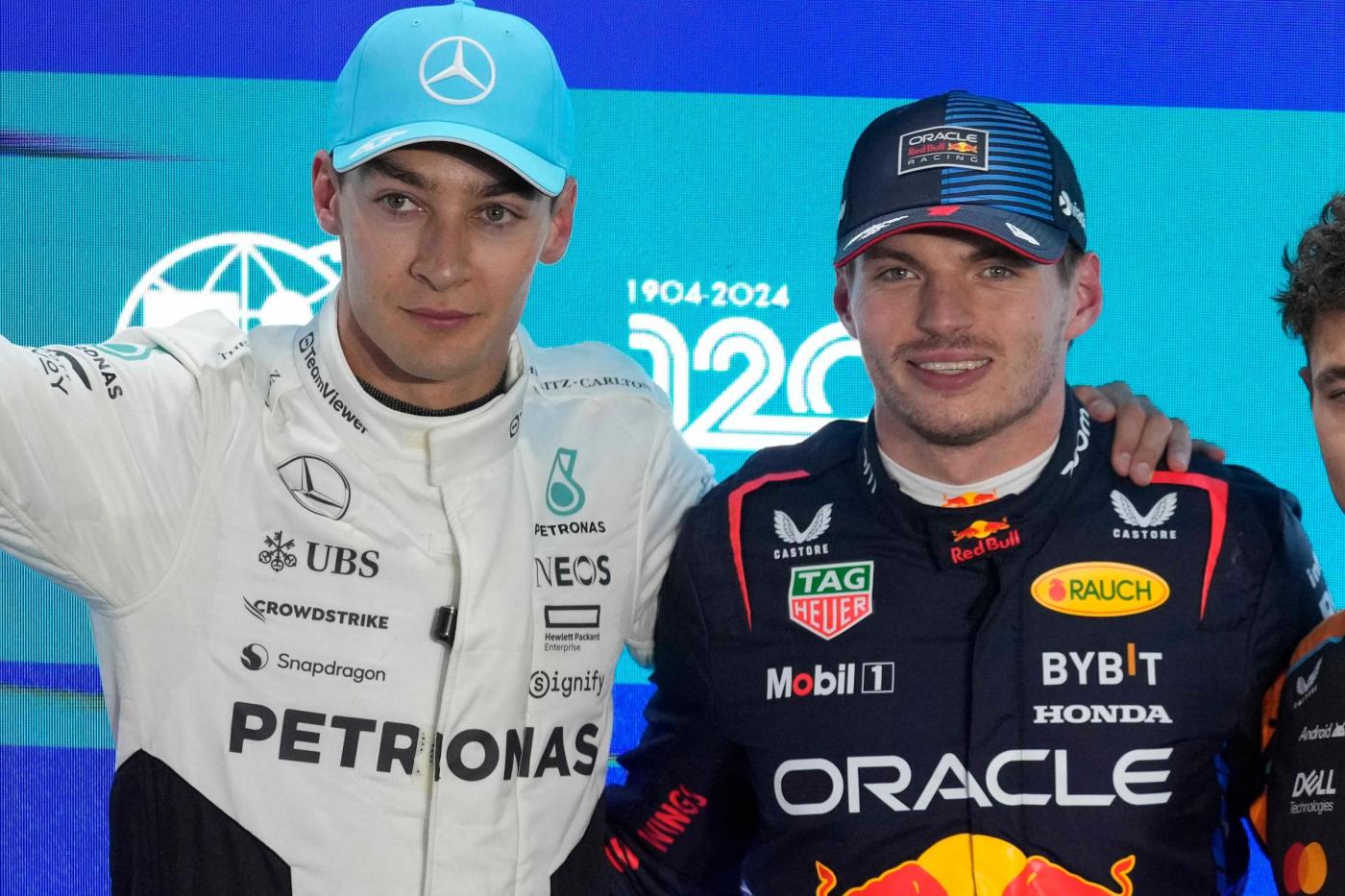
Max Verstappen has been penalized for “driving unnecessarily slowly” during the qualifying session for the Qatar Grand Prix, which had significant implications for his rival, George Russell. This incident occurred in the closing stages of the qualifying round and forced Russell to take evasive action, ultimately affecting his ability to secure a better lap time.
As the session unfolded, Russell was poised to start from pole position after putting in a strong performance earlier in the session. However, Verstappen’s unexpected deceleration in the third sector caught Russell off guard. As he approached Verstappen’s slowing car, Russell was forced to make a quick decision to avoid a collision, which resulted in him running onto the kerb and subsequently onto the gravel. This unexpected maneuver likely hindered his chances of improving on his initial lap time.
After the session ended, the stewards convened to review the incident. Verstappen was summoned to explain his actions, and Russell was invited to share his account as well. The deliberation took over three hours before a ruling was communicated, indicating the complexity of the situation and the attention it warranted.
Typically, the penalty for such impeding behavior would be more severe, often resulting in a three-place grid penalty. However, the stewards took into account several mitigating factors in this case. They acknowledged that Russell had clear visibility of Verstappen as he approached and noted that during the incident, neither driver was on a push lap. This context significantly influenced their decision, leading to a more lenient one-place grid penalty for Verstappen.
In addition to the grid penalty, Verstappen received one penalty point on his FIA super licence, bringing him halfway to the threshold of 12 points within a year, beyond which a driver faces a one-race ban. This aspect of the ruling adds to the weight of the incident, as consistent infractions could lead to more substantial repercussions for Verstappen in the future.
The outcome of the incident has implications for the race dynamics, especially for George Russell, who now stands a better chance at securing back-to-back victories following his recent triumph in Las Vegas. Yet, it’s important to note that the controversy surrounding Verstappen’s penalty may not provoke significant backlash, given that he has already clinched the drivers’ championship for a fourth consecutive season.
During the stewards’ review, various sources of evidence were considered, including positioning and marshalling system data, video footage, timing, telemetry, and in-car radio communications. The deliberation highlighted that Car 1 (Verstappen) was following a different preparation strategy compared to Car 63 (Russell). Verstappen explained that he had allowed other cars to pass, which contributed to the difficult situation for Russell.
Russell, for his part, defended his adherence to the delta time, expressing his disbelief that Verstappen was on the racing line at that moment. He argued that a car significantly slower than the expected pace should not occupy the racing line, particularly in a high-speed section of the track.
Overall, the stewards described the case as intricate, noting that Verstappen’s actions did not align with the Race Director’s Event Notes. They concluded that he was indeed driving unnecessarily slowly under the circumstances, particularly as he attempted to cool his tires while being fully aware of Russell’s approaching presence, having glanced in his mirrors on multiple occasions prior to the incident. This insightful assessment underlines the complexities and challenges that drivers face during intense qualifying sessions, where every decision can have a profound impact on the outcomes of races.
 World of sports
Leave a comment