
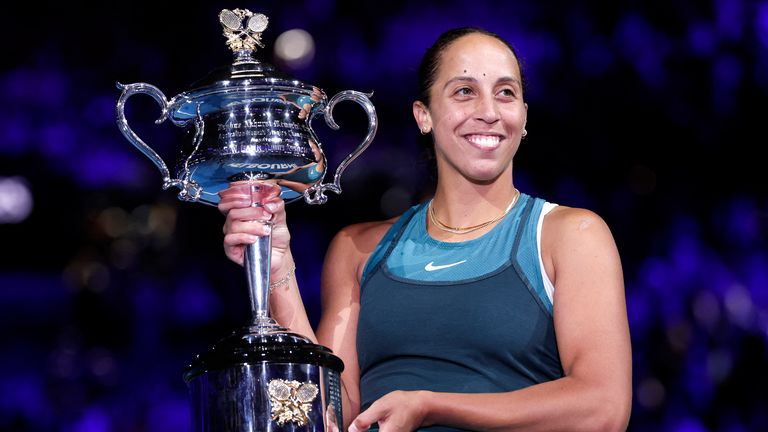
Madison Keys made history on Saturday by dethroning world No. 1 Aryna Sabalenka, becoming the oldest first-time winner of the women’s singles title at the Australian Open. This landmark achievement not only reflects her incredible talent but also signifies a remarkable journey filled with challenges and perseverance.
The match was an intense battle, with Keys delivering a stunning upset that denied Sabalenka the opportunity to claim her third consecutive Australian Open title. Sabalenka had been aiming to carve her name into tennis history by becoming the first woman since Martina Hingis in the late 1990s to secure three straight championships at Melbourne Park. The weight of such expectations may have caused some additional stress, disrupting her usual rhythm and composure during the match.
For Keys, this victory was a realization of a long-cherished dream, particularly after the struggle she faced in her earlier career. Turning professional at the tender age of 14, there were times when it seemed as though she would never capture the elusive Grand Slam title that many had predicted would be in her grasp. Her path to success took a significant turn when she upset the tournament’s second seed, Iga Swiatek, in the semi-finals, gaining momentum and confidence heading into the final match.
When the pivotal moment arrived, Keys didn’t falter. After sealing a tense 6-3, 2-6, 7-5 victory on the legendary Rod Laver Arena, she rushed towards her coaching area, overwhelmed with emotion. There, she embraced her husband and coach, Bjorn Fratangelo, who has been instrumental in her recent success. His unwavering support and guidance served as a critical factor in her breakthrough, reinforcing the idea that behind every successful athlete, there often lies a strong support system.
While Keys celebrated, Sabalenka’s visible frustration manifested itself when she smashed her racket—a reaction that underscored the intense pressure and expectations that came with her role as the top player in women’s tennis. What made this final particularly compelling was the contrast between Sabalenka’s reputation for power and Keys’ newfound strategy of aggression combined with tactical play.
Reflecting on her previous Grand Slam final experience at the US Open eight years ago, where nerves had reduced her game to an underwhelming performance, Keys had determined to take a more fearless approach this time around. She expressed in the lead-up to the match that she had been closely studying Sabalenka, learning not to shrink from the high-stakes moments that could define a match. This preparation paid off; she returned to the court with a mindset ready to assert her game rather than simply respond to her opponent.
In contrast, Sabalenka struggled to find her footing from the start, casting anxious looks toward her player box as she tried to regain control. The opening game set an ominous tone, with two double faults, while Keys quickly took advantage, breaking serve to establish a solid 5-1 lead. Her aggressive gameplay put Sabalenka on the defensive, highlighting a power dynamic that left the top seed scrambling.
Though Keys had a set point in the lengthy seventh game, Sabalenka was skillful enough to escape that moment with a decisive serve. Despite losing the initial set, which Keys ultimately secured, the back-and-forth nature of the match kept spectators engaged as the intensity ramped up.
As the match progressed, there was a noticeable shift in Keys’ performance; her first-serve percentage began to drop, indicating she might be feeling the immense pressure of the situation. Sabalenka, after taking a bathroom break to regroup, re-entered the match with renewed determination and began to find her rhythm. Keys had to fend off a series of attacks from Sabalenka, who displayed her trademark power with slicing forehands that consistently caught Keys off guard.
Yet amidst the rising tension of the match, Keys exhibited incredible mental fortitude. Just as she had withstood the pressure while facing Swiatek, she remained resolute against Sabalenka. With the quality of play only intensifying as the match neared its conclusion, the statistics revealed just how evenly matched the two athletes were.
Finally, as Sabalenka prepared to serve at 5-6—on the brink of having to face a decisive tie-break—Keys sensed the moment slipping away and rose to the occasion. With fervor and precision, she reinforced her momentum by sending back powerful returns that caught Sabalenka off her game. Keys seized the opportunity, earning two match points; she captured the first with an extraordinary shot that solidified her victory.
This win for Madison Keys stands as a triumphant declaration of hard work, resolve, and the realization that dreams can eventually be turned into reality, even after years of striving toward a seemingly unreachable goal. Her journey serves as an inspiration not only to aspiring tennis players but also to anyone pursuing their ambitions, demonstrating that with dedication and perseverance, monumental achievements are within reach.
 World of sports
Leave a comment