
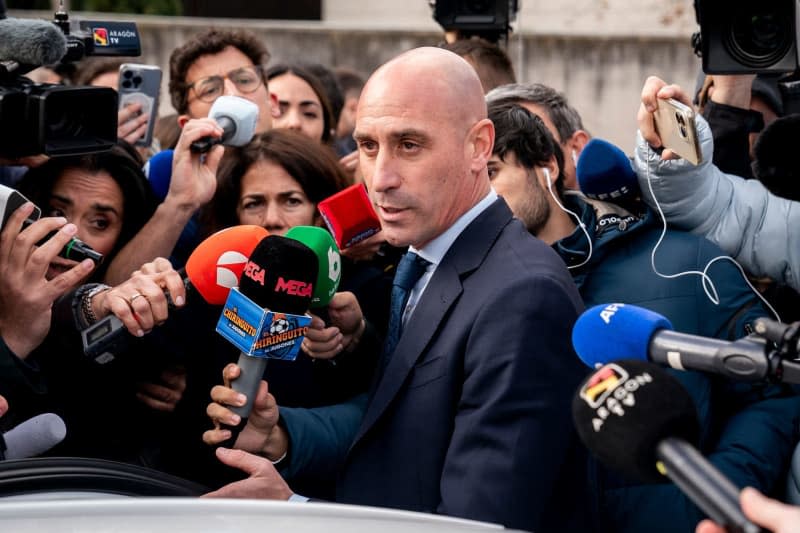
Luis Rubiales has taken the stand in a Spanish court, expressing firm belief that Jenni Hermoso, the Spanish footballer, gave her consent prior to their controversial kiss during the Women’s World Cup final in 2023. This incident has sparked widespread debate and legal scrutiny, with Rubiales, the former president of the Royal Spanish Football Federation (RFEF), facing trial for sexual assault as well as accusations of trying to coerce Hermoso into publicly stating that the kiss was consensual.
In his testimony, Rubiales emphasized that the kiss was an “act of affection” and described it as a spontaneous gesture that celebrated Spain’s victory in the tournament. The incident occurred during the medal-giving ceremony after Spain secured their World Cup win in Australia, an occasion that has since led to protests and demands for Rubiales’s resignation. He maintains that he has done nothing criminally wrong.
During the court proceedings, Rubiales recounted a moment filled with joy and camaraderie. He stated, “I’ve known her for many years and I kissed her because she was a champion. This was a tremendous moment for her.” He further clarified that Hermoso initiated a close embrace during the ceremony and that their interaction was mutually celebratory. “We were champions, we were thanking each other. She pressed me very hard by the waist, and then I asked her whether I could give her a kiss, and she said yes,” he claimed.
When pressed for specific details by the prosecutor, Marta Durantiez, regarding his choice of words at that moment—whether he asked for a “kiss” or a “little kiss”—Rubiales admitted he could not recall his exact phrasing but speculated that it was likely a “little kiss.” This uncertainty seemed to weigh on the proceedings, as he navigated through questions about his intentions and adherence to social norms regarding physical affection, especially in a professional context.
He acknowledged that while he felt the occasion warranted such a gesture, he recognized the existing protocols against sexual harassment and sexual violence, stating, “I am aware of it.” Furthermore, he articulated that he would have acted similarly with male players or even his daughters during celebratory events, revealing his perspective on casual displays of affection.
To bolster his defense, Rubiales presented evidence from a lip-reading expert, who indicated that, in analyzing the relevant video footage, Rubiales had inquired “can I give you a kiss?” The expert noted, however, that Hermoso’s response was not visible, creating ambiguity around the exchange. Another specialist corroborated that the video was authentic and unaltered, lending some credibility to Rubiales’s position.
In stark contrast, Hermoso’s testimony has painted a very different picture of the event. She has insisted that she did not grant Rubiales permission for the kiss, stating that it had “stained one of the happiest days of my life.” Hermoso articulated that such an act, particularly involving her superior, should not occur in any context, social or professional. She emphatically stated, “A kiss on the lips is only given when I decide so.”
Hermoso has also recounted feeling pressured shortly after the kiss to issue a statement that downplayed the severity of the incident, which she vehemently refused. Furthermore, she revealed her distress following the event, stating that Rubiales approached her on the flight home, requesting her to record a video in response to the backlash he faced on social media. The situation escalated to the point where she received death threats, compelling her to relocate her family to Mexico, where she currently plays.
The trial continues to unfold, reflecting deep divisions over consent and appropriate conduct in professional sports, with significant implications for both Rubiales and Hermoso. The eyes of the public remain fixed on this landmark case as it explores the boundaries of consent, power dynamics, and respect in athletic environments.
 World of sports
Leave a comment