
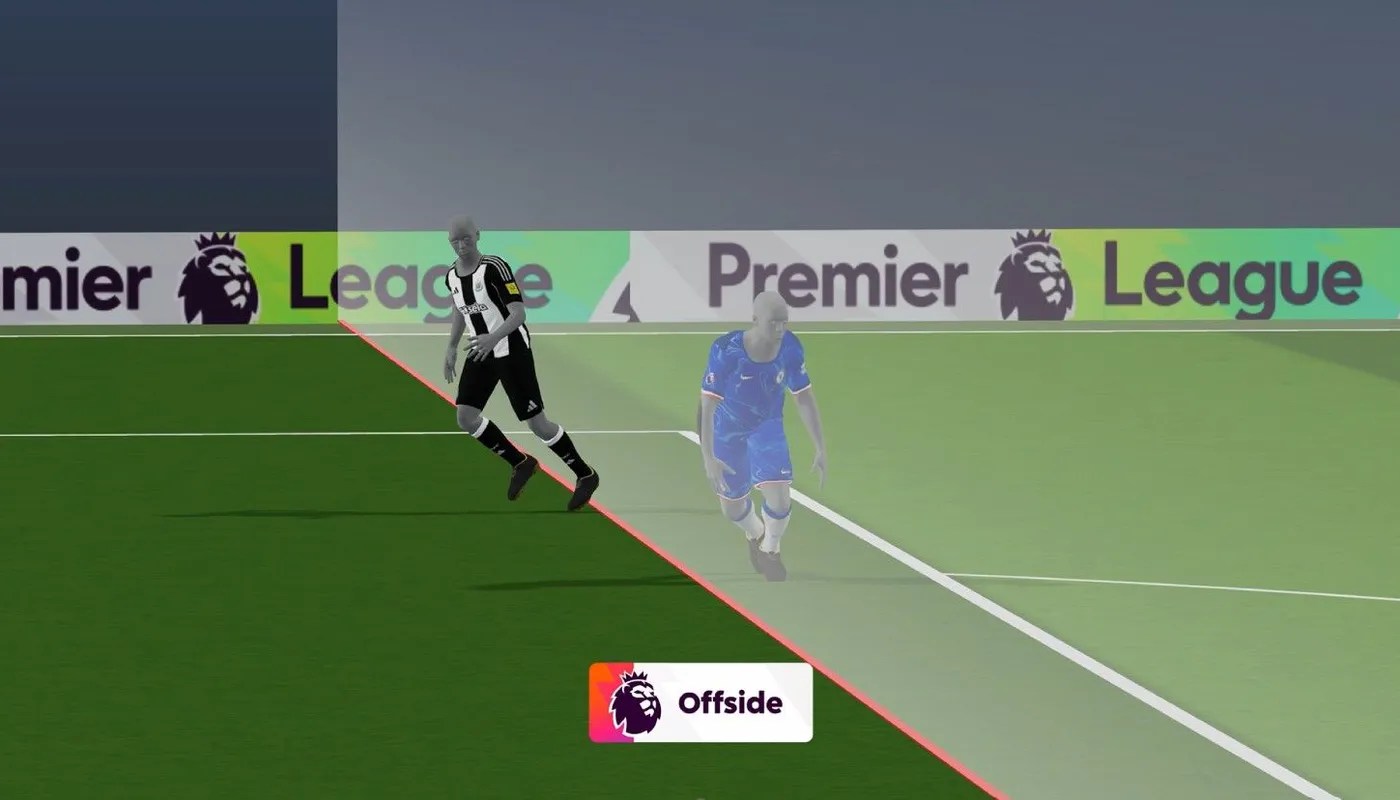
The Premier League is set to embrace a significant advancement in football officiating by introducing semi-automated offside technology for the first time on Saturday, April 12. This innovative system represents a major leap forward in the way offside decisions are made, responding to the evolving demands of the modern game.
According to a statement released by the Premier League, this state-of-the-art technology aims to enhance the integrity of the offside decision-making process while simultaneously improving the speed, efficiency, and consistency of results. The introduction of semi-automated offside technology comes after extensive non-live testing earlier this season, along with successful live operations in the FA Cup. Such groundwork has paved the way for its implementation in top-flight matches, even though the Premier League originally planned to roll it out after the October or November international breaks this season.
At the heart of this technology’s operation is its ability to assist officials in precisely placing the virtual offside line when analyzing tight calls. This is made possible through advanced player tracking systems, which collect extensive data to provide a more accurate assessment of each player’s positioning at critical moments in the match. The technology not only enhances accuracy for the officials but also generates virtual graphics that can be displayed for viewers both in the stadium and at home, enriching the overall spectator experience.
Each Premier League stadium will be equipped with up to 30 tracking cameras that operate at twice the frame rate of typical broadcast devices. This array of cameras is crucial for making quicker and more accurate offside decisions. The elevated frame rate allows for a better understanding of player movements and ball positioning, ensuring that even the most marginal of offside calls can be assessed with high precision. These cameras, powered by the sports data and technology company Genius Sports, will track not only the ball but also thousands of individual data points for each player on the pitch.
When a significant action occurs—be it a penalty shootout, a goal, or a red card—the system springs into action, using the data collected to analyze whether any attacking player involved was in an offside position at the moment the ball was played. If a player is found to have received the ball while offside, an alert is automatically generated and sent to the officials stationed in the Video Assistant Referee (VAR) hub. The VAR team will then verify the situation, checking the exact moment of contact and informing the on-field referees, thereby facilitating a more efficient decision-making process.
Notably, the Premier League anticipates that, on average, the implementation of semi-automated offside technology will result in offside decisions being made more than 30 seconds faster than before. However, it is important to note that there may still be instances that could lead to delays. These could arise due to situations where the ball is obscured (occluded) from view by a cluster of players, “edge decisions” that are too close to call, or subjective interpretations regarding a player’s interference with play. In such cases, intervention from the VAR and possibly the on-field referee will be required.
While this semi-automated offside technology is not entirely new to the world of football—having been successfully utilized during the 2022 World Cup—it represents a significant development for the Premier League. The planned introduction in autumn 2024 was postponed, making this upcoming implementation all the more anticipated by fans and stakeholders alike. As this technology rolls out, it marks a pivotal step in ensuring that the beautiful game continues to evolve, marrying tradition with modern innovation for the benefit of all involved.
 World of sports
Leave a comment