
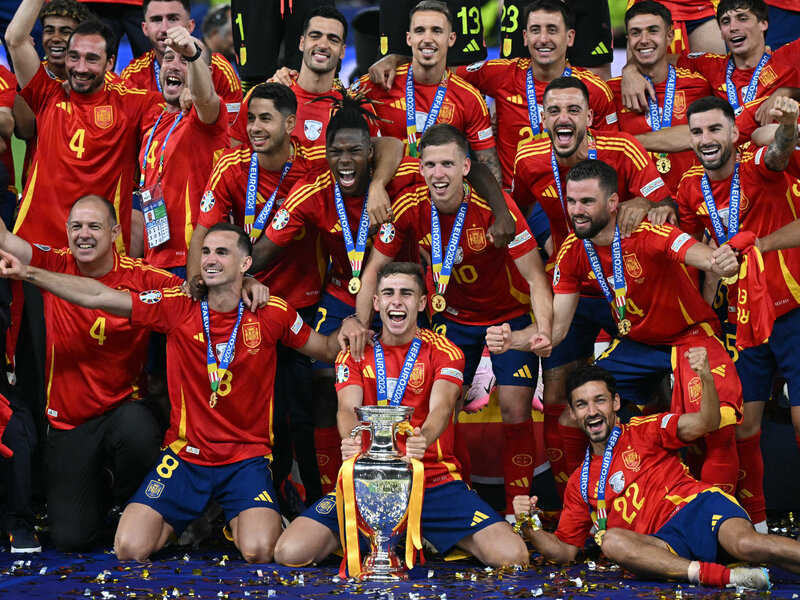
Could we imagine a World Cup devoid of Spain? If Israel were to participate, this scenario could actually unfold. This notion was suggested by Patxi Lopez, the spokesperson for the Socialist Group in Congress, who remarked that “at the appropriate time,” the possibility of Spain abstaining from the 2026 FIFA World Cup could be taken into consideration should Israel join the competition.
This stance taken by the Spanish government arises amidst a heated discussion surrounding Israel’s involvement in international sporting events, a topic that has gained renewed prominence in Spain recently. The intersection of sports and politics has never been more pronounced, igniting fervent debates among politicians, athletes, and fans alike. During a recent press conference in Congress, López called upon sports organizations to take action and “exclude” Israel from competitions, drawing parallels to the measures enacted against Russia following its aggressive actions in Ukraine.
The Socialist spokesperson made it clear that he intends to petition governing bodies responsible for competition entry to impose a veto against Israel’s participation. This begs the question: Would Spain truly consider withdrawing from competitions, such as the 2026 FIFA World Cup, for which it has qualified? López’s vague assertion, “That’s what we’re doing now, we’ll consider it later,” seems to imply that discussions about Spain’s potential exit from the World Cup are indeed underway, stirring considerable speculation about the government’s commitment to this course of action.
From the perspective of football, Israel is intricately involved in the struggle to qualify for the upcoming FIFA World Cup. The Israeli team is currently in a fiercely competitive group, alongside established footballing nations such as Italy, Norway, Estonia, and Moldova. With 9 points from five matches, Israel occupies the third position in the group, which places them on the brink of both automatic qualification and a playoff opportunity. Their resilience on the field has been palpable, demonstrating that they are a force to be reckoned with.
Tensions rise further when we look at their recent performances, particularly their nail-biting match against Italy, where Gennaro Gattuso’s squad narrowly managed to defeat Israel (4-5) in a dramatic conclusion. Such thrilling exchanges exemplify the unpredictable nature of sports, illustrating how capable the Israeli team is, even against much-favored opponents. Currently, Norway is leading the group, their path to qualification appearing promising, while a fierce competition for the playoff spot lies ahead, particularly between Italy and Israel.
All eyes will be on the crucial encounter scheduled for October 14 in Udine, a match laden with implications not just for the teams but also for the broader perception of Spain’s involvement in the tournament. This pivotal game could very well affect the fortunes of both Israel and Italy as they vie for a chance to compete on the grand stage of the World Cup. Furthermore, the potential ramifications for Spain’s role in the tournament underscore the complexity of blending sports with political narratives, stirring passions and discourse that extend far beyond the pitch. As the date approaches, it is likely that discussions surrounding Spain’s participation and its contingent factors will reach a fever pitch, captivating the interest of both sports enthusiasts and political commentators.
 World of sports
Leave a comment