
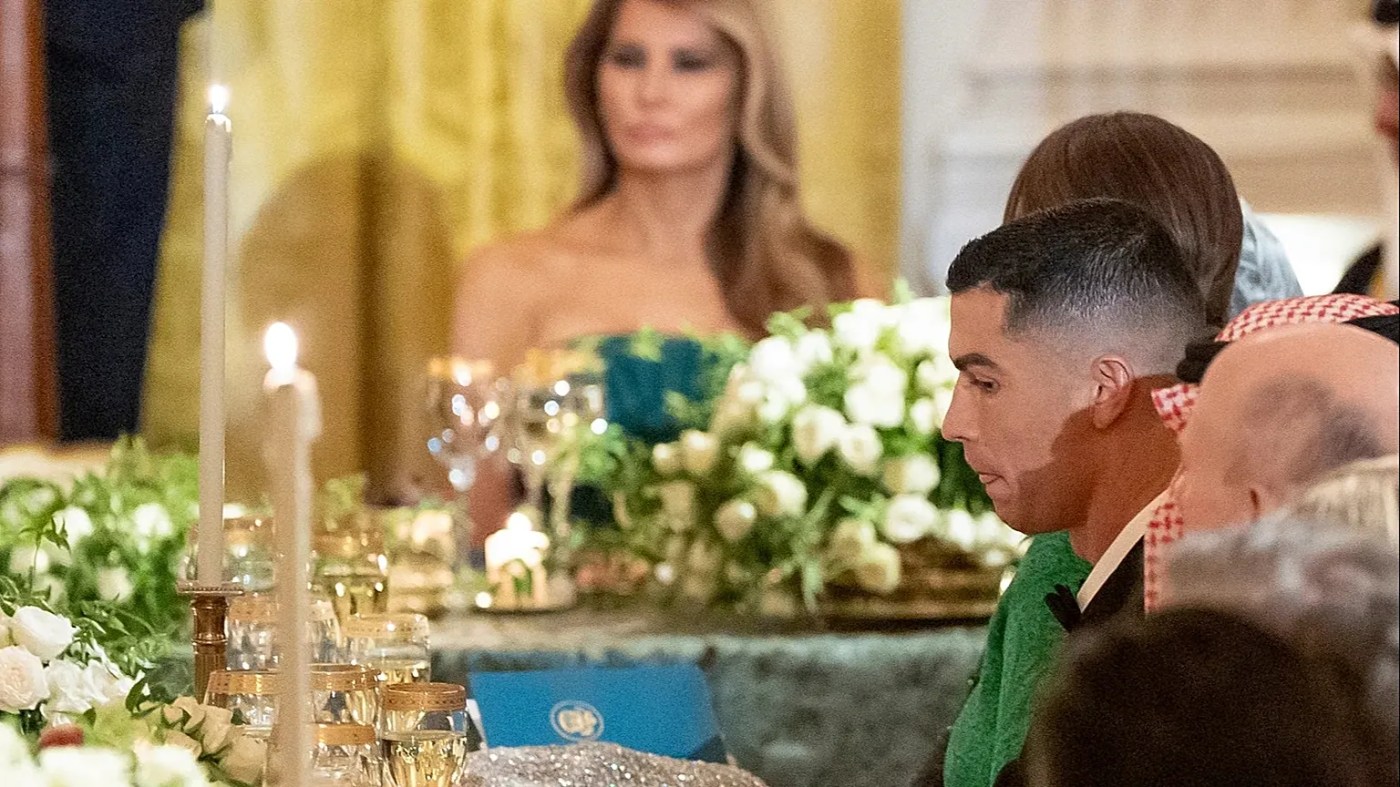
Cristiano Ronaldo made headlines by attending a prestigious black-tie dinner at the White House, alongside the crown prince of Saudi Arabia, Mohammad bin Salman. This event took place on a Tuesday night and garnered considerable media attention due to the intertwining of sports, politics, and economics.
In his remarks leading up to this significant gathering, U.S. President Donald Trump expressed great pride in hosting Ronaldo. The Portuguese forward has emerged as a prominent figure in the Saudi football league, symbolizing the country’s efforts toward modernization and societal reform. Ronaldo’s involvement in the league is not merely about sports; it reflects Saudi Arabia’s larger ambition to diversify its economy and move away from its traditional reliance on oil revenue. Such efforts are part of the nation’s Vision 2030 initiative, which aims to transform the kingdom into a global hub for business and tourism.
A representative from the White House verified Ronaldo’s attendance earlier in the day but did not clarify if he was officially part of bin Salman’s delegation. The meeting’s implications are multi-dimensional, as many observers and critics argue that Saudi Arabia’s extensive investment in sports serves to enhance its image and provide a distraction from its less favorable human rights record and environmental issues associated with its oil production, a practice commonly referred to as “sportswashing.”
During the dinner event, Trump used his platform to speak favorably about the strengthened relationship between the United States and Saudi Arabia, declaring the kingdom a “major non-NATO ally.” Earlier that day, he had a formal engagement with the crown prince in the Oval Office, reaffirming the importance of their diplomatic ties. As he turned his attention to Ronaldo, Trump mentioned that his son, Barron, is a significant fan of the football star, implying that meeting Ronaldo has positively impacted his son’s impression of him, which adds a familial layer to his admiration for such a global sports icon.
In attendance alongside Ronaldo was tech magnate Elon Musk, who mingled with other influential business figures, including Tim Cook, CEO of Apple. Interestingly, this marked Musk’s first return to the White House since resigning from his position in the Trump administration’s Department for Government Efficiency (Doge) back in April. The billionaire’s relationship with Trump has been marked by public disputes, including Musk’s announcement to form a new political party, highlighting the dynamics between politics, technology, and global business interests.
This event also marked one of Ronaldo’s first known visits to the United States since 2016. During this time, he weathered serious allegations of sexual assault leveled by Kathryn Mayorga, who accused him of rape in a Las Vegas hotel room in 2009—a claim Ronaldo has consistently denied. In a statement released in 2018, he remarked, “I firmly deny the accusations being issued against me. Rape is an abominable crime that goes against everything that I am and believe in.” In 2019, U.S. prosecutors ultimately decided not to pursue charges against him, citing insufficient evidence to support the claims.
As 2023 began, Ronaldo transferred to Saudi Arabia to further his career, taking the helm as the captain of the Al Nassr football team, which is backed by the Saudi Public Investment Fund—a financial entity led by Crown Prince Mohammad bin Salman. In a sport that has seen a financial explosion, Ronaldo’s contract with Saudi Arabia set new standards, reportedly worth $200 million (£152 million) annually—that’s over half a million dollars per day.
By June of this year, he renegotiated his contract for an additional two years amounting to a staggering total of $400 million (£300 million). This contract not only solidified his status as one of the highest-paid athletes but also made him football’s first billionaire player, as reported by Bloomberg, with his net worth climbing to an unparalleled $1.4 billion.
This substantial financial success for a veteran athlete nearing the end of his career is remarkable. Analysts like Sanam Vakil, who leads the Middle East and North Africa program at Chatham House, indicated that Saudi Arabia has heavily invested in prominent figures and high-profile events as part of its strategy to elevate its presence in the global sports and tourism sectors, aimed at fostering a modernized image for the kingdom.
Ronaldo himself has referred to bin Salman as “our boss” in an interview with broadcaster Piers Morgan, an indication of the close ties forming between the footballing icon and Saudi leadership. Earlier this month, he also participated in a Ministry of Tourism event in Riyadh, advocating for the kingdom’s developmental projects and expressing hope for Saudi Arabia to host the FIFA World Cup in 2034, which would underscore and amplify the country’s burgeoning role on the international sports stage as it further embraces its modernization ambitions.
 World of sports
Leave a comment