
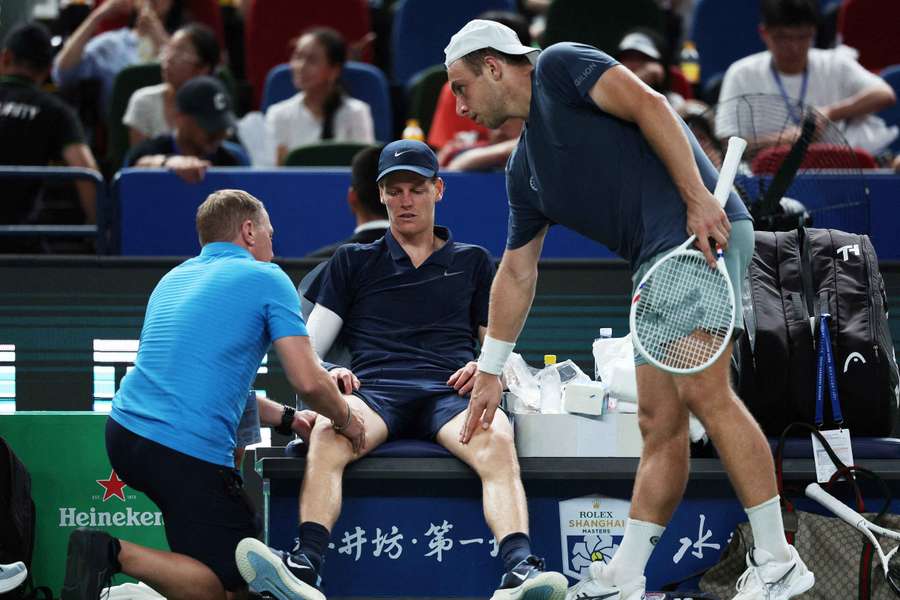
The ATP will introduce a new extreme heat rule from the 2026 season that aims to enhance player safety during competitions in high temperatures. This policy will permit players on the men’s tour to take a 10-minute cooling break during best-of-three sets singles matches. This significant change is reminiscent of the WTA’s proactive measures enacted over 30 years ago to safeguard players from the risks posed by extreme heat conditions, highlighting the progressive nature of sports organizations in prioritizing athlete welfare.
The decision comes in response to alarming incidents like the one at the Shanghai Masters in October 2023, where temperatures soared to 34C and humidity levels reached a staggering 80% during daylight hours. Following a distressing episode during his third-round match, where world number 15 Holger Rune required medical assistance, he voiced his concerns to an official, questioning: “Do you want a player to die on court?” Such statements underscore the urgent need for regulations that effectively address player safety in increasingly harsh playing environments.
In a structured statement, the ATP clarified that the intention behind this new policy is to “strengthen protections for players competing in extreme conditions.” The rule is founded on the Wet Bulb Globe Temperature (WBGT) index, a comprehensive metric that gauges heat stress by taking into account various factors, including temperature, humidity, wind speed, sun angle, and cloud cover. This scientific approach aims to ensure that player well-being is at the forefront of tournament operations.
When the WBGT level hits 30.1C or higher during the initial two sets of a best-of-three format, either player will have the option to seek a 10-minute cooling break. During this time, which will be monitored by ATP medical personnel, players are permitted to hydrate, change into fresh clothing, shower, and even receive coaching, effectively creating a support system for athletes grappling with adverse weather conditions.
Moreover, should the WBGT surpass 32.2C, all play will be temporarily suspended to protect player health. The ATP emphasized that “the new heat rule provides a structured, medically supported approach to managing extreme heat, with the objective of safeguarding player health, while also improving conditions for spectators, officials, ball persons, and tournament staff.” This holistic consideration reflects an understanding that the welfare of players directly impacts the overall experience of everyone involved in the sport.
Players have increasingly expressed their concerns about the oppressive heat at both men’s and women’s tournaments, specifically at major events like the Grand Slams. The challenges faced during recent competitions, like the Shanghai Masters and Wuhan Open, drew widespread criticism for the punishing conditions. Notable athletes shared their struggles: Emma Raducanu, representing Britain, had to retire from her first-round match due to dizziness attributed to heat exhaustion. Novak Djokovic, a 24-time Grand Slam winner, described the conditions as “brutal,” while Giovanni Mpetshi Perricard lamented feeling as though he was “dying on the court” because of the stifling humidity. Additionally, Jelena Ostapenko revealed that she had suffered from heat stroke, forcing her to withdraw from her match due to illness.
The pre-existing women’s WTA heat rule, implemented since 1992, is consistently enforced year-round at all tournaments, often serving as a benchmark for measures that protect players within the context of extreme weather. With the ATP adopting these new guidelines for the men’s tour, it signifies a critical step toward ensuring that athletes are provided with a safer and more humane playing environment in the years to come.
 World of sports
Leave a comment