
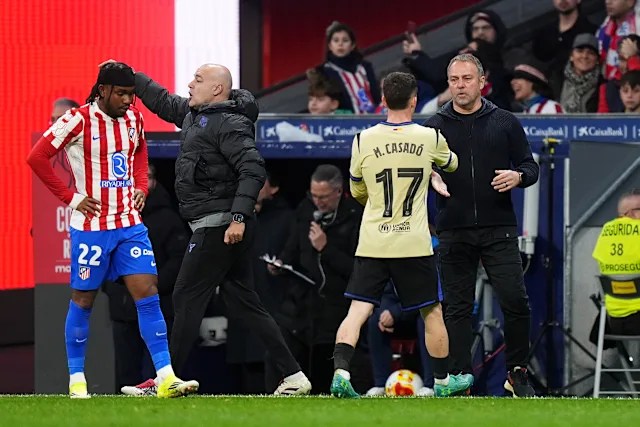
Barcelona experienced a crushing defeat in their recent match against Atletico Madrid, marking their most significant loss of the season and severely diminishing their chances of advancing to the Copa del Rey final. Throughout the match, Atletico consistently capitalized on defensive errors made by the Catalan team, highlighting serious concerns regarding Barcelona’s tactical setup and readiness to face one of their fiercest rivals.
In the aftermath, Flick conveyed his pride in the team’s overall performance throughout the season, acknowledging the progress made in various tournaments. Nonetheless, rumors began to circulate in Catalonia that the day after the match was unprecedented in terms of Flick’s frustration with his players since his tenure began. The German manager specifically pointed out the lack of intensity, commitment, and energy demonstrated by his squad during the first half, emphasizing that these deficiencies played a crucial role in their downfall against Atletico.
On the other hand, the Barcelona players were reluctant to accept full responsibility for the defeat, believing that external factors significantly contributed to their inability to compete effectively. Reports from The Athletic highlighted that the players initiated a series of unscheduled discussions with Flick post-match, where they openly communicated their sentiments regarding the match conditions. They argued that the environment was far from conducive for Barcelona to implement Flick’s preferred tactics, including a high defensive line and a rigorous pressing system. This discussion underscored the players’ understanding of their limitations and their acknowledgment that successful execution of tactics requires more than just the manager’s vision.
This heavy loss was not an isolated incident but rather part of a concerning trend in recent performances. Matches such as the 3-3 draw against Club Brugge and the 4-1 rout by Sevilla were brought up, revealing a pattern of struggle against specific styles of play. The squad has vocalized a desire for a more pragmatic approach when facing certain teams, advocating for strategic adjustments based on the opponent’s characteristics and their own team’s strengths and weaknesses.
Another crucial factor identified by the players was the absence of key individuals like Pedri and Raphinha, which they believed played a significant role in their difficulties on the pitch. Without Pedri’s ability to maintain possession and control the midfield, paired with Raphinha’s impact on both pressing and offensive play, the team found it increasingly challenging to execute Flick’s demanding tactics effectively. The players felt that these absences created substantial hurdles that made it difficult to adapt to the tactical demands placed upon them.
Ultimately, the players’ goal was not to challenge Flick’s overarching tactical philosophy but rather to suggest a more adaptable approach tailored to the specific context of each match. They hoped to foster a more flexible game plan, one that could take into account the nuances of the opponents they faced and the personnel available that day. This constructive engagement illustrates the evolution of the squad and their commitment to improving performance, showing a willingness to collaborate with their manager on tactical matters while striving for a more effective and coherent team strategy going forward.
 World of sports
Leave a comment