
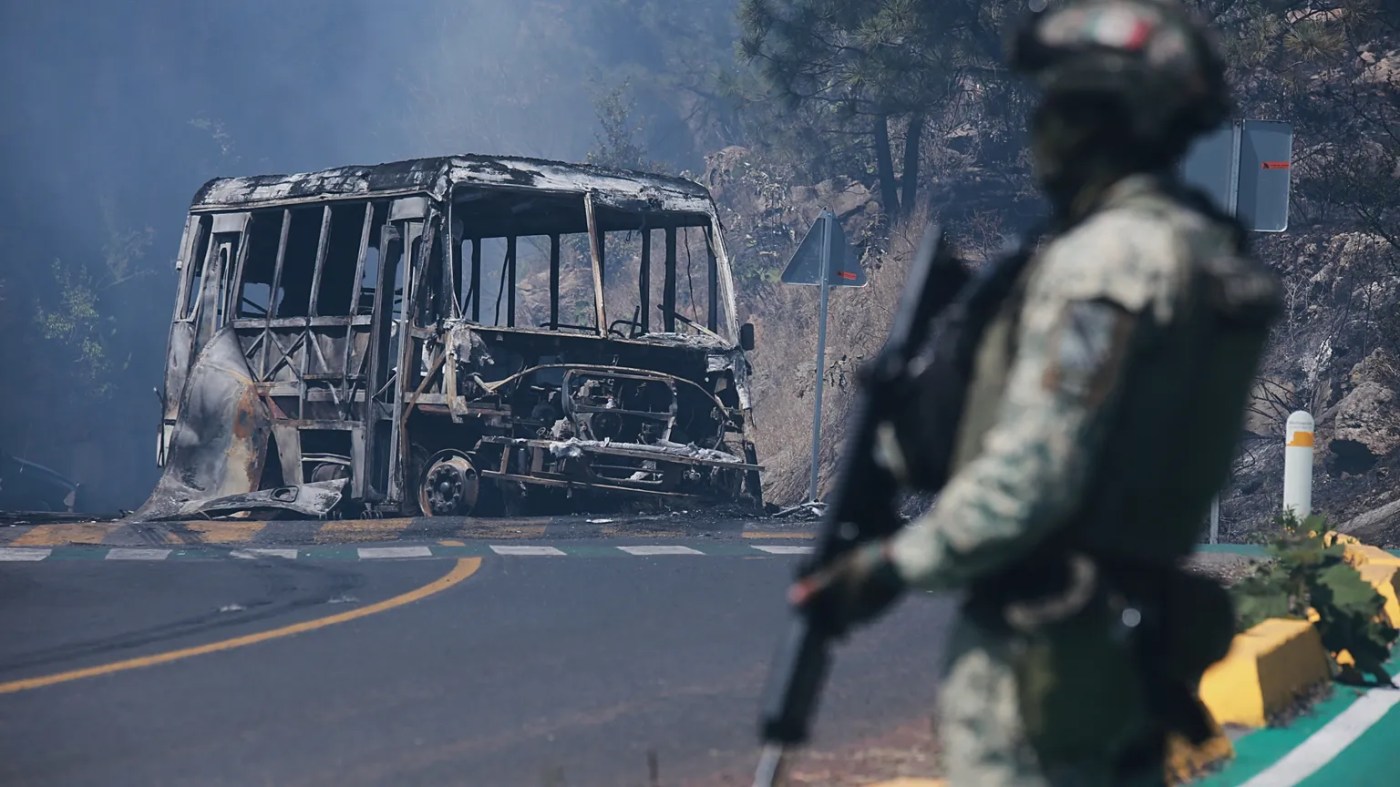
Mexico’s role as a co-host of this summer’s FIFA World Cup has been cast into uncertainty following a dramatic surge in cartel-related violence that erupted on Sunday, raising concerns among security analysts and international observers.
The violence began after the reported killing of Nemesio Oseguera Cervantes, widely known as “El Mencho,” during a military operation. Oseguera Cervantes was the long-time leader of the Jalisco New Generation Cartel (CJNG), one of Mexico’s most powerful and feared criminal syndicates. In retaliation, the cartel launched coordinated attacks against Mexican security forces, engaging in gun battles with the military, erecting roadblocks, torching vehicles and spreading fear across multiple regions.
The unrest first broke out in Jalisco, where authorities declared a “code red” security emergency. From there, violence quickly spilled into at least a dozen other areas. Videos circulating online showed armed men patrolling city streets while plumes of smoke rose above urban skylines. Within 24 hours, at least 25 members of Mexico’s National Guard had reportedly been killed.
The city of Guadalajara — home to more than one million residents — is scheduled to host four World Cup matches. A further five games are due to be played in Mexico City and another four in Monterrey, making security in these areas critical to the tournament’s success.
Javier Eskauriatza, assistant professor of criminal law at the University of Nottingham, warned that crackdowns on major cartels often provoke immediate and forceful retaliation.
“When you push down on the cartels you do get pushback,” he said. “The danger is that it can be very difficult to manage a security situation that spirals out of control.”
He added that the death of El Mencho could create a power vacuum within the CJNG, potentially triggering internal struggles as factions compete to assume leadership — a scenario that may fuel further instability in the short term.
However, Eskauriatza noted that criminal organizations often have a vested interest in maintaining stability during major international events. “In general, the cartels have an economic interest in making sure the World Cup is peaceful,” he explained. “Yes, they pay off politicians and local police forces, but they also buy restaurants and own hotels. They are part of the economic system.
“It is useful for them if Brits, Americans and others go to Mexico, spend their money and have a good time.”
The CJNG is believed to be worth more than £10 billion and to command tens of thousands of members. Since its emergence in 2009, it has been linked to massacres, kidnappings and assassinations of political figures. Yet in some communities, certain cartel leaders maintain a degree of local support by funding infrastructure projects and community facilities.
Eskauriatza suggested the cartel’s dramatic response was calculated. “The response by the CJNG is, in a way, required by the rules of the game — if you have your leader nabbed, you have to respond, otherwise you look weak,” he said. “They are not idiots — they know that social media will film and amplify these videos for them, and they have made sure the response looks national.”
International reaction has been swift. The United States government has advised Americans in Jalisco to shelter indoors until further notice, while Canada — another World Cup co-host — has cancelled flights to Puerto Vallarta airport. Flight-tracking data indicated that several aircraft turned back mid-journey amid security concerns.
Dr Karina Garcia-Reyes, senior lecturer in criminology at UWE Bristol, offered a measured assessment of the risk to visitors.
“In terms of tourists, I would say there will be a moderate risk for them,” she said. “Unless more military operations are conducted this week, I would expect that the authorities in the most affected areas will be able to address potential risks. So overall, I would expect tourists to be safe as long as they follow the authorities’ indications.”
Security planning for the World Cup was already under scrutiny before the outbreak of violence in Mexico. In the United States, debate has intensified over the deployment of Immigration and Customs Enforcement (ICE) officers to major cities by President Donald Trump, following fatal incidents involving federal agents and a series of protests. Last month, Football Supporters Europe expressed “extreme concern” about what it described as the increasing militarisation of policing in the US.
Now attention has shifted firmly to Mexico and whether authorities can reassure travelling fans that adequate security will be in place. The immediate impact of the violence was evident on Sunday when four domestic football matches — two in the top division and two in the second tier — were postponed.
Monica Serrano Carreto, professor of international relations at El Colegio de Mexico, said many Mexicans are hoping the violence represents a short-lived backlash rather than the beginning of a prolonged conflict.
“People in Mexico are hoping that this is a one-off retaliation and that as the cartel reorganises itself, things will settle down,” she said. “But there is also a risk that this leads to a new period of instability, unpredictability and the violence continues.
“The type of weapons that the cartel has access to means that a military-style confrontation in the aftermath is inevitable — the government would have known that. We have seen in the past they even have weapons capable of shooting down helicopters.
“I think it will already have had an impact on how people view coming to Mexico because the images are top of the news around the world.”
Jon Benjamin, the UK’s ambassador to Mexico from 2021 to 2024, described the situation as unusually severe, though not unprecedented.
“This response is not unique but is very serious and very high scale,” he said. “President Trump has designated the cartels as terrorist organisations and Mexico has already handed over dozens of cartel figures to them. The Trump factor is very important in what is happening.”
As Mexico prepares to welcome the world for football’s biggest tournament, the coming weeks may prove decisive. Authorities must now demonstrate that the security situation can be stabilised — not only to protect residents, but also to reassure the millions of fans expected to travel for the World Cup.
 World of sports
Leave a comment