
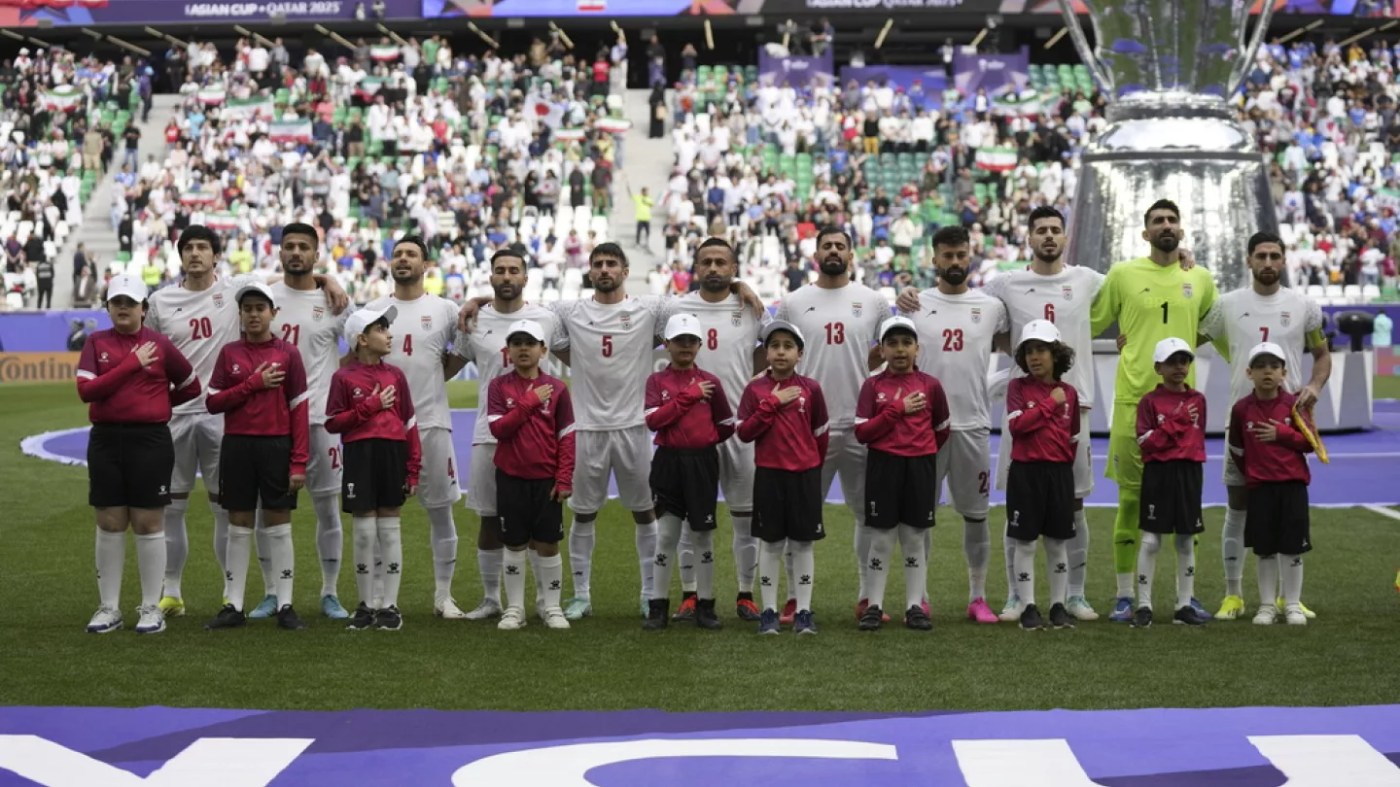
With just over 100 days until the United States co-hosts the next men’s football World Cup, a major geopolitical crisis has cast fresh uncertainty over what was already shaping up to be one of the most politically charged tournaments in modern history.
The US carried out military strikes against Iran on Saturday as part of a joint operation with Israel, triggering retaliatory attacks across the Middle East. The escalation comes despite Iran having already qualified for what would be their fourth consecutive World Cup. Now, the conflict raises profound questions about whether Iran will participate at all — and what the wider ramifications could be for the tournament, for Fifa, and for the US as host nation.
Iran’s Participation in Doubt
Iran were drawn to face New Zealand and Belgium in Los Angeles, followed by Egypt in Seattle. They were not removed from the competition last summer after US strikes on three Iranian nuclear facilities. However, following this latest escalation — and particularly the reported killing of Iran’s Supreme Leader, Ali Khamenei — the political situation inside Iran has become highly volatile.
Mehdi Taj, head of Iran’s football federation, has reportedly cast doubt over participation. He told Iranian television:
“With what happened… and with that attack by the United States, it is unlikely that we can look forward to the World Cup, but the sports chiefs are the ones who must decide on that.”
Given the upheaval inside the country and uncertainty about the political chain of command, even identifying who would ultimately make such a decision may be difficult.
Dr Sanam Vakil, director of the Middle East and North Africa Programme at Chatham House, warned the situation is far from a limited confrontation:
“For Tehran, this is not a short 12-day war or a contained round of escalation that can be paused and reset.
This new stage of conflict is existential and clearly about regime survival. It is also unlikely to end quickly.”
That assessment suggests Iran’s potential withdrawal would not be a symbolic gesture but part of a much larger national crisis.
Fifa’s Position — and Replacement Scenarios
Football’s world governing body, FIFA, says it is monitoring developments. Privately, officials are reportedly still expecting Iran to take part. On Saturday, Fifa general secretary Mattias Grafström stated:
“Our focus is to have a safe World Cup with everybody participating.”
Should Iran withdraw, Fifa regulations allow for replacement by another team from the Asian Football Confederation (AFC). Iraq — who could yet qualify via a continental play-off — or the United Arab Emirates, who narrowly missed qualification, would be considered leading candidates.
Meanwhile, Iran’s women’s team continues preparations for the Asia Cup in Australia. The squad trained as scheduled on the Gold Coast. The AFC said:
“The AFC’s foremost priority remains the welfare, safety and security of all players, coaches, officials, and fans. In this regard, we are in close and regular contact with the Iran women’s national team and officials on the Gold Coast and are offering our full support and assistance.”
At a pre-match press conference, Iran coach Marziyeh Jafari avoided political commentary, focusing instead on football:
“The tournament is a chance to show the potential of Iranian women.”
Security Concerns in the US
Even if Iran participates, security around their matches — and their planned training base in Arizona — would likely face intense scrutiny.
US President Donald Trump signed an executive order last year banning nationals from 12 countries, including Iran, from entering the US on security grounds. World Cup players and staff are exempt, but tensions surrounding immigration policy could inflame the atmosphere.
Security challenges are not unprecedented. At the 2022 World Cup in Qatar — including a politically charged match against the US — Iran’s fixtures were played against the backdrop of anti-government protests at home. During the Wales match, confrontations occurred between Iranian fans holding opposing political views.
Nick McGeehan of human rights group FairSquare said the present situation is without precedent:
“We are in uncharted territory in that we are just over three months away from the start of the World Cup and the hosts have just launched a war of aggression against a participating country.
If Iran withdraws its team — an outcome that seems entirely plausible — Fifa is likely to breathe a sigh of relief given the scope for protest and unrest.”
Even if Iran does not compete, security planning across the 11 US host cities is expected to intensify. The tournament will coincide with celebrations of the 250th anniversary of the US Declaration of Independence, and President Trump is expected to maintain a highly visible presence, as he did at recent major sporting events.
Preparations were already under strain. US officials had recently warned of “catastrophic” security consequences if host cities failed to receive funding frozen during a partial government shutdown. Concerns have also mounted over the potential role of Immigration and Customs Enforcement (ICE) at the tournament, and instability in neighbouring co-host Mexico.
Over the weekend, Andrew Giuliani, head of the White House’s World Cup taskforce, praised the strikes on Iran, writing on social media that they would “make the world a safe place.” He added:
“We’ll deal with soccer games tomorrow. Tonight we celebrate [the Iranian people’s] opportunity for freedom.”
Growing Scrutiny of Fifa and Infantino
The conflict is also likely to intensify criticism of Fifa president Gianni Infantino over his close relationship with President Trump.
In December, Fifa awarded Trump its inaugural “Peace Prize” at the 2026 World Cup draw ceremony, praising him for playing “a pivotal role” in securing a ceasefire between Israel and the Palestinians and for efforts to resolve other conflicts. Since then, the US has undertaken military action in Venezuela, Nigeria and Iran, and signalled potential operations elsewhere.
Last month, Infantino defended the award and appeared at the first meeting of the US President’s Board of Peace wearing a Trump-themed “USA” cap branded “45-47,” referencing Trump’s two terms in office.
Critics argue such gestures undermine Fifa’s claim of political neutrality. In January, 27 UK opposition politicians signed a parliamentary motion urging international sporting bodies to consider expelling the US from major competitions, including the World Cup, arguing such events “should not be used to legitimise or normalise violations of international law by powerful states.” A German Football Association official also publicly suggested a boycott should be considered.
Calls for action may now intensify — whether directed at the US for initiating military action, or at Iran for retaliatory strikes affecting Gulf states.
Fifa has previously faced similar dilemmas. The 2018 World Cup proceeded in Russia despite international criticism following the annexation of Crimea and other allegations. Russia was eventually banned by Fifa in 2022 after its invasion of Ukraine, when several European nations refused to compete against it. Infantino has since suggested that ban should be lifted, arguing isolation has not worked.
There is currently no indication that Fifa is considering sanctions against the US.
A Tournament Under a Political Cloud
What is clear is that the geopolitical context surrounding the World Cup has dramatically shifted in just 48 hours. What was already a complex political landscape — involving immigration policy, security funding, international relations and domestic unrest — has now become significantly more volatile.
Whether Iran competes or withdraws, the World Cup will unfold under intense global scrutiny, with football once again intersecting directly with geopolitics at the highest level.
 World of sports
Leave a comment